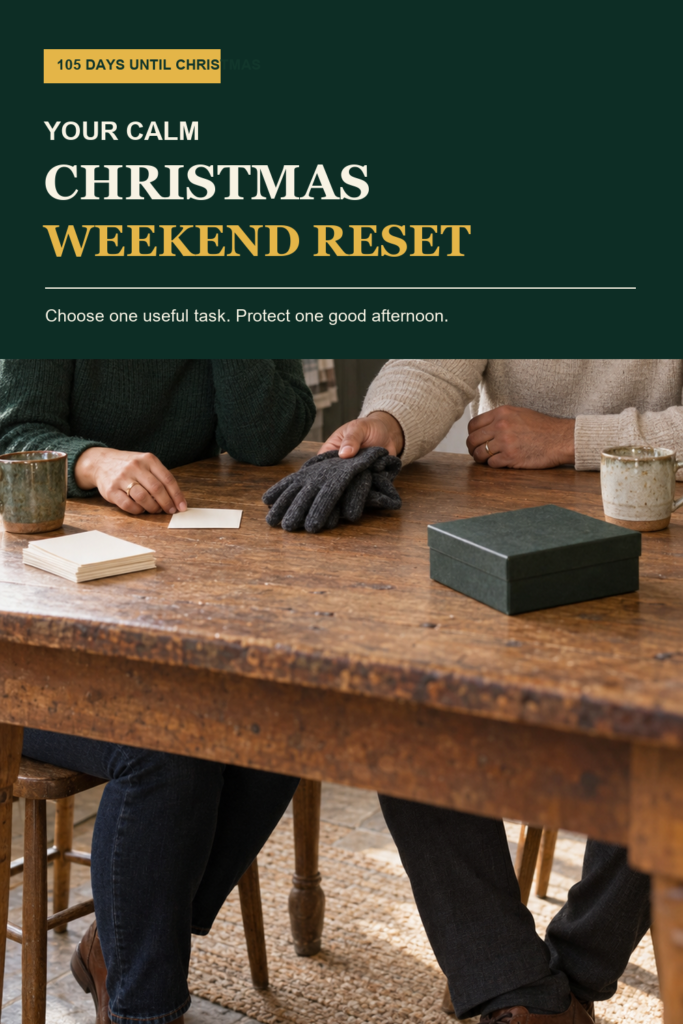
On September 11 there are 105 calendar days until Christmas. That is enough time to make the season easier without turning every Saturday into a project. The useful question is not how much you can finish this weekend. It is what one decision would make the rest of the year calmer.
A good weekend reset has two parts. Pick one small practical task that reduces a future problem, then protect one activity that makes the season feel worth preparing for. The task gives you progress. The activity gives you a reason not to let Christmas become a checklist.
Make the weekend small on purpose
Christmas planning goes wrong when every unfinished thought turns into an urgent job. A gift idea becomes a shopping trip, then a delivery deadline, then three more names to solve. A dinner idea becomes a dozen recipes and a crowded grocery cart. It is tempting to answer that pressure with a longer list. Usually, a shorter list works better.
Start with one thing that will make December lighter. It could be writing down the people you are buying for, setting a total gift limit, checking who will travel, deciding who hosts dinner, or testing one recipe before the ingredients become harder to find. Give it a clear finish line. “Think about gifts” is not a finish line. “Write a name beside each person and one useful clue” is.
Then add one thing that is enjoyable without being productive. Walk somewhere cold, watch a film you already know, make hot chocolate with a child, call an older relative, or take an afternoon where Christmas is not discussed at all. That second choice matters. A plan that leaves no room for the feeling people want from Christmas is only a busier version of ordinary life.
The one-task, one-afternoon card
Write four short lines on paper before the weekend starts:
- One decision: What are we settling now?
- One task: What can be fully finished in thirty to sixty minutes?
- One good afternoon: What will we enjoy together?
- One thing we will not do: What are we deliberately leaving for another day?
Here is a realistic example. The decision is that the household will exchange gifts only with immediate family. The task is to create a gift brief for each person using the Christmas Gift Planning Ideas guide. The good afternoon is a walk followed by soup at home. The thing they are not doing is browsing for presents before they know what each person would actually use.
Nothing on that card is spectacular. That is why it survives a normal weekend. It does not require a perfect morning, a large budget, or everyone being in the same mood. It leaves room for other plans changing.
Choose a task with a real payoff
The best early tasks remove uncertainty. They do not create piles of supplies. Pick one based on the kind of pressure you are most likely to feel later:
- If money tends to be the problem, set a total first and use the Holiday Budget Tracker to separate gifts, food, travel and the inevitable unplanned cost.
- If meals become stressful, save three recipes you would genuinely serve and make one small test batch. The recipe ideas guide includes make-ahead notes so you can rule out dishes that do not fit your week.
- If family coordination is the problem, send one message that settles a date, a host or a travel decision. Do not start a group chat about every possible detail.
- If you tend to buy too much, make a list of traditions that cost almost nothing but people remember. A film, a bedtime story, a particular breakfast or a familiar walk can do more than another parcel.
It helps to treat the live Christmas countdown as a clock for choices rather than a warning. There are 15 full weeks at this point. You do not need fifteen large projects. A handful of small decisions, made before sales and delivery cutoffs arrive, changes the shape of December.
Let the plan fit the people in it
Some households want a full table and a loud house. Others are planning around a shift at work, a long drive, grief, a new baby, a small flat, a complicated family relationship or a tight month. The same Christmas plan cannot serve all of them. Your reset should make your own circumstances more visible, not copy someone else’s version of the season.
When the weekend is over, put the card somewhere you will see it. If the one task is finished, let it be finished. Do not reward yourself by adding five more. The point is to prove that preparation and pleasure can live in the same day. That is a better habit to carry toward Christmas than a crowded list.